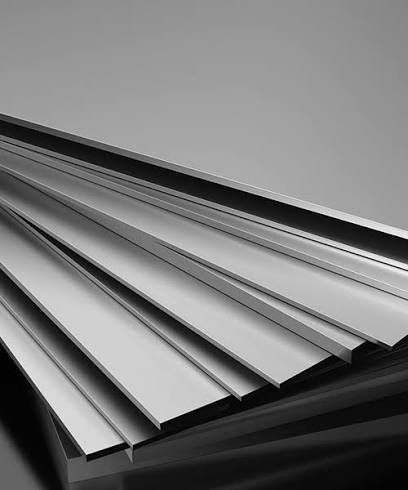
Sailesh Metal Corporation supplies stainless steel sheets and plates across the standard austenitic, ferritic and martensitic grade range, produced and tested to ASTM/ASME A240 and equivalent specifications. Sheets and plates form the base material for a large share of fabrication work — tanks, vessels, structural cladding, kitchen and dairy equipment, and components later formed into pipes, fittings or flanges — so grade selection here has a direct bearing on the corrosion resistance and mechanical performance of the finished product.
Our range runs from cost-efficient utility grades through to high-alloy, high-nickel sheet and plate for aggressive service, giving buyers a single source for stock and project-specific sheet/plate requirements.
Quick Overview
Requirement
Available Range / Details
Grades Offered
301, 304, 304L, 310S, 316, 316L, 317, 317L, 321, 347, 409, 410S, 410, 420, 430 and specialty grades on request
Governing Standard
ASTM/ASME A240
Thickness Range
Sheet: 0.3 mm to 3 mm (typical) | Plate: above 3 mm, up to heavy-gauge sizes on request
Width / Length
Standard mill widths and lengths, with cut-to-size available
Surface Finish
2B, No.1, No.4, No.8 mirror, BA (bright annealed), and custom finishes on request
Delivery Condition
Hot rolled annealed & pickled (HRAP), cold rolled annealed & pickled (CRAP), or as specified
Documentation
EN 10204 3.1, Mill Test Certificates, chemical and mechanical test reports, PMI reports where required
Grades & Indicative Composition
The table below summarises indicative chemical composition limits (in percentage) for commonly stocked grades. Buyers should confirm the exact grade, thickness and finish at the enquiry stage.
Grade
Cr
Ni
Mo
304
18.00–20.00
8.00–10.50
—
304L
18.00–20.00
8.00–12.00
—
316
16.00–18.00
10.00–14.00
2.00–3.00
316L
16.00–18.00
10.00–14.00
2.00–3.00
317L
18.00–20.00
11.00–15.00
3.00–4.00
321
17.00–19.00
9.00–12.00
—
347
17.00–19.00
9.00–13.00
—
310S
24.00–26.00
19.00–22.00
—
410
11.50–13.50
0.75 max
—
430
16.00–18.00
0.75 max
—
Grade Selection Notes
304 / 304L
The general-purpose austenitic workhorse grade, offering good corrosion resistance and formability for equipment and structural work not exposed to aggressive chlorides. 304L carries lower carbon for improved weldability without post-weld sensitisation.
316 / 316L / 317L
Molybdenum-bearing grades offering improved resistance to pitting and crevice corrosion in chloride-bearing and marine environments, with 317L carrying a higher molybdenum content still, for more aggressive service.
321 / 347
Titanium- (321) and niobium-stabilised (347) grades, chosen where the sheet or plate will be welded and then exposed to elevated temperature service, since stabilisation resists intergranular corrosion after welding.
310S
A high-chromium, high-nickel grade selected for elevated-temperature and furnace-related applications where oxidation resistance at heat is the priority.
410 / 420 / 430
Martensitic (410, 420) and ferritic (430) grades used where moderate corrosion resistance is acceptable in exchange for higher hardness, wear resistance or lower cost, common in cutlery, fasteners and general engineering.
Industries & Applications Served
Tank, vessel and equipment fabrication
Chemical and pharmaceutical processing
Food processing, dairy and kitchen equipment
Architecture, construction and structural cladding
Base material for pipe, fitting and flange manufacture
Why Choose Sailesh Metal Corporation
Metals trade experience since 1975
Broad grade range from utility to high-alloy sheet and plate under one roof
Support for both standard stock sizes and cut-to-size requirements
Documentation support including EN 10204 3.1 MTC and test reports
Mumbai-based supply operation serving buyers across India and export markets
How to Send an Enquiry
Share the following details so our team can quote accurately:
Grade required (e.g. 304L, 316L, 321, 347, 310S)
Sheet or plate, and thickness required
Width and length, or cut-to-size dimensions
Surface finish required
Quantity and applicable standard
Frequently Asked Questions
What is the difference between a sheet and a plate?
The distinction is generally thickness-based — material up to about 3 mm is typically referred to as sheet, while thicker material is referred to as plate, though exact cut-offs can vary by standard and supplier convention.
Which grade should I choose for a chloride-exposed environment?
316 or 316L is the standard choice for moderate chloride exposure, with 317L offering a further step up in molybdenum content for more aggressive conditions.
Can 321 and 347 plate be used interchangeably?
Both are stabilised grades chosen for post-weld, elevated-temperature service. 321 uses titanium stabilisation and 347 uses niobium; project specifications often call for one specifically, so the choice should follow the applicable spec.
Do you supply cut-to-size sheets and plates?
Yes, cut-to-size supply is available in addition to standard mill sizes, subject to grade, thickness and quantity.
What documentation is provided with sheet/plate supply?
EN 10204 3.1 Mill Test Certificates, chemical and mechanical test reports, and PMI reports where required, can be provided subject to order terms.